
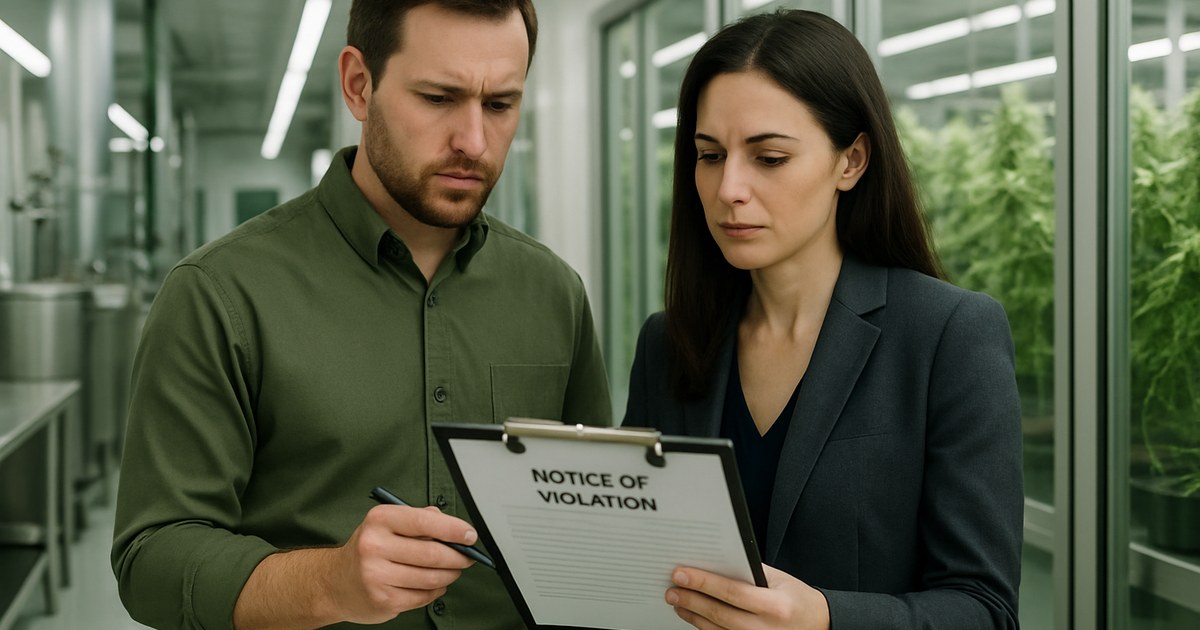
An inspector walks out. A week later a letter arrives with a case number on it. That letter is a cannabis notice of violation, and what you do in the next 72 hours has more effect on the outcome than anything your lawyer argues three months from now. Operators lose licenses over paperwork responses far more often than they lose them over the underlying conduct.
What Is a Cannabis Notice of Violation?
It is the regulator formally alleging that you broke a rule, and formally starting a clock for you to respond. It is not a fine yet, and it is not a license revocation. It is the opening of an administrative file that can end in a warning, a monetary penalty, a settlement agreement with conditions, a suspension, or revocation.
Most notices identify the rule cited, the factual allegation, the response deadline, and whether you are entitled to a hearing. Read all four. Operators routinely respond to what they assume the inspector meant instead of to the rule actually cited, which is how a minor labeling issue turns into an admission on a records violation nobody was going to pursue.
How Long Do You Have to Respond to a Cannabis Notice of Violation?
Commonly 30 days, and sometimes far less for a hearing request or a corrective action plan. The response deadline and the hearing-request deadline are frequently two different dates on the same page, which is the single most expensive detail people miss.
| State | Regulator | Typical response posture |
|---|---|---|
| Illinois | IDFPR and the Department of Agriculture | Written response plus corrective action; discipline follows the Cannabis Regulation and Tax Act |
| Ohio | Division of Cannabis Control | 30 days from service to request an adjudication hearing |
| Michigan | Cannabis Regulatory Agency | Formal complaint, then settlement conference or administrative hearing |
| Missouri | Department of Health and Senior Services | Written response and cure, with disciplinary action appealable |
| New York | Office of Cannabis Management | Notice and cure for many violations; escalation for serious findings |
Ohio codifies the 30-day hearing request at Ohio Revised Code 119.07, and Illinois discipline runs under the Cannabis Regulation and Tax Act. Michigan publishes its disciplinary process through the Cannabis Regulatory Agency. Verify against your own notice rather than against a chart, including this one.
9 Critical First Moves After a Cannabis Notice of Violation
1. Diary both deadlines the day it arrives
Response deadline and hearing-request deadline. Separately. Waiving a hearing by silence is permanent in a way that almost nothing else in this process is.
2. Stop the conduct, and document that you stopped
If the allegation is accurate, remediation started immediately is the best mitigation argument available. Timestamped photos, corrected logs, retraining sign-in sheets. Regulators discount promises and credit evidence.
3. Do not admit anything in writing yet
A friendly email conceding the violation before you understand the penalty exposure removes every piece of leverage you had. Acknowledge receipt, state that a substantive response is coming, and stop there.
4. Pull your own records before the agency asks
Seed-to-sale exports, surveillance retention, manifests, training files, standard operating procedures in effect on the date alleged. You need to know whether the allegation is true before you decide how to respond to it.
5. Find out whether this is isolated or systemic
If the inspector found one mislabeled package, the question the agency will ask is whether your process produces mislabeled packages. Audit the category yourself. Volunteering a fixed systemic problem lands much better than having it discovered at a hearing.
6. Identify every person who touched the issue
Then make sure they are not improvising explanations to the regulator. Route all communication through one person. Inconsistent staff statements do more damage in these files than the violations do. Clear written policies in a cannabis employee handbook prevent most of this before it starts.
7. Price the settlement against the fight
Many notices resolve in a consent agreement with a fine and conditions. That is often the right outcome. But read the conditions carefully, because agreeing to enhanced reporting or a compliance monitor for two years is a real operating cost that rarely shows up in the headline number.
8. Check what the notice does to your other obligations
Lenders, landlords, insurers and investors frequently have notice covenants triggered by regulatory action. So do license applications pending in other states, which usually ask about disciplinary history. A quiet local fine can become a disclosure problem in a state you have not entered yet.
9. Get counsel involved before you send the response
The written response becomes part of the permanent record and gets read by whoever decides the penalty. It is worth having someone who has read a hundred of these look at yours.
Holding a notice of violation with a deadline on it? Talk to a cannabis compliance attorney before you put anything in writing to the regulator.
When Does a Cannabis Notice of Violation Threaten Your License?
When it is repeated, when it involves diversion or minors, or when the response itself becomes the problem. Single technical violations, cured promptly and documented well, very rarely cost anyone a license.
What escalates a file is a pattern. Three similar notices over eighteen months tells a regulator your controls do not work, and that is a different proceeding than three unrelated technical findings. Diversion, sales to minors, untracked inventory and falsified records sit in their own category and should be treated as serious from the first hour.
The third escalation path is self-inflicted: missed deadlines, inconsistent statements, or a response that argues with the rule instead of addressing the facts. If a proceeding does move toward suspension or revocation, the appeal mechanics look much like the ones described in our guide to what to do when a cannabis license is denied, and the same short administrative clocks apply.
Building the controls that keep notices from arriving is ordinary operations work, and the compliance and standard-operating-procedure teams at Collateral Base do that for licensed operators. Tracking enforcement trends through Cannabis Legalization News is a cheap way to see which rules your state has decided to start enforcing this year. If your operation spans states, a cannabis licensing lawyer should be reviewing how disciplinary history in one market reads on an application in another.
Frequently Asked Questions
Can I lose my license over one cannabis notice of violation?
Rarely, unless the violation involves diversion, sales to minors, or falsified records. Most single technical violations resolve with a corrective action plan and sometimes a fine.
Should I just pay the fine and move on?
Sometimes, but read what you are signing first. Consent agreements often carry conditions such as enhanced reporting or monitoring that outlast the fine by years, and they establish a disciplinary record that follows you into other states.
Do I have to let inspectors in without a warrant?
Licensed cannabis operations are generally subject to administrative inspection as a condition of licensure, and refusing entry is itself typically a violation. Have a written inspection protocol so staff know what to do rather than deciding in the moment.
Does a notice of violation become public?
Often yes. Many states publish disciplinary actions, and most license applications in other states require you to disclose them. Assume it will be visible and handle it accordingly.
This article is general information about cannabis regulatory enforcement and is not legal advice. Procedures, deadlines and penalties vary by state and change over time, and the language of your specific notice controls. Reading this does not create an attorney-client relationship. Consult a licensed attorney in your jurisdiction.