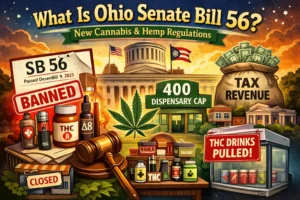
As of March 20, 2026, Ohio’s approach to cannabis regulation just got a whole lot more restrictive. Senate Bill 56 didn’t just tweak Issue 2—it basically hit the reset button on parts of what voters approved in 2023. If you’re operating a cannabis business in Ohio, running a hemp company, or thinking about entering the market, you need to understand what this law actually means for you. And frankly, some of it’s pretty wild.
This is a massive update to Ohio cannabis law, and non-compliance isn’t an option. Let’s break down Ohio SB 56 cannabis law 2026 in plain English.
The Big Picture: What SB 56 Actually Does
Ohio SB 56 represents something we don’t see very often in cannabis policy: a rollback of voter-approved regulations. In November 2023, Ohio voters said “yes” to Issue 2, which created a framework for both medical and adult-use cannabis sales. But in early 2026, the legislature essentially said “thanks, but we’re going to do this our way”—and the result is a framework that’s more restrictive in some areas, more confusing in others.
The law consolidates medical and adult-use cannabis under a single regulatory body (the Division of Cannabis Control) but then proceeds to add regulations that make operating as a cannabis business significantly harder than voters originally approved. The biggest casualties? Hemp products, social equity funding, and the actual number of licenses that can exist.
Here’s what changed, and why it matters:
The Hemp Ban: Goodbye Delta-8, Delta-10, and Intoxicating Cannabinoids
If you’re currently selling delta-8 gummies, delta-10 edibles, THC beverages, or any other intoxicating hemp-derived product in Ohio, you have a serious problem. As of March 20, 2026, all intoxicating hemp products are banned with one narrow exception: products purchased through licensed cannabis dispensaries.
This is a complete sea change from the pre-SB 56 world, where hemp-derived cannabinoids were completely legal to sell in gas stations, smoke shops, and online retailers. If you’re currently holding inventory of delta-8 products, delta-10 products, or any hemp-derived intoxicating cannabinoid products, you need to speak with a lawyer immediately about your options. Selling through unlicensed channels is now explicitly illegal.
The only legitimate path forward for intoxicating hemp products is through the licensed dispensary system. If you’re not currently licensed—or on track to be licensed—you need to make a decision: exit the market, apply for a dispensary license, or partner with someone who has one.
This ban also affects consumer possession. More on that below, but the headline is: having delta-8 or other intoxicating hemp products that weren’t purchased through a licensed dispensary is a legal problem for your customers too.
Dispensary Caps and Buffer Zones: The 400-License Ceiling
Ohio SB 56 caps the total number of dispensaries at 400 statewide. That’s it. No exceptions, no expansion path. This is a significant departure from the original Issue 2 framework, which had a more permissive approach to license issuance.
But the dispensary cap isn’t the only barrier. SB 56 also mandates:
- 1-mile buffer between dispensaries – You can’t have two licensed dispensaries within a mile of each other
- 500-foot buffer from schools, playgrounds, churches, and libraries – Same as federal rules, basically
What does this mean in practice? In rural or suburban areas, you might find that the 1-mile buffer zone makes it mathematically impossible to get a dispensary license, even if you otherwise meet all the requirements. In densely populated urban areas, the math is different, but competition for the limited licenses will be fierce.
If you’re thinking about applying for a dispensary license, you need to do a detailed geographic analysis before you invest time and money in an application. Some areas of Ohio have simply run out of available locations.
Possession and Transportation: The 2.5-Ounce Rule and the Original Packaging Requirement
Adults in Ohio can now legally possess cannabis—but only within strict constraints. Here’s what you can and can’t do:
- 2.5 ounces outside the home maximum (possession limit increases to 5.5 ounces inside the home)
- Must be in original, unopened packaging when transported
- Must be in the trunk or inaccessible storage while in a vehicle
- Cannot be purchased from another state – This one’s important: even if you buy legally in Michigan, bringing it into Ohio is a crime
That last point bears repeating because it’s going to catch a lot of people off guard. Yes, Michigan has legal cannabis. Yes, Ohio is right next to Michigan. No, you cannot legally bring Michigan cannabis into Ohio. Possession of cannabis purchased from another state is explicitly prohibited under SB 56. Law enforcement is likely going to hammer this point at the border.
The original packaging requirement is interesting because it creates obvious compliance questions: What if the packaging is damaged? What if you bought a 7-gram pre-roll and consumed 2 grams—is the opened packaging now illegal? The Division of Cannabis Control will need to issue guidance on these edge cases, and you should expect that guidance to be somewhat restrictive.
Public Consumption and New Criminal Charges
SB 56 introduced a new criminal offense: public consumption of cannabis. This includes consuming any cannabis product—flower, edibles, beverages, everything—in public. The law specifically calls out edibles and gummies, which is notable because the general public might not think of gummies as “smoking in public.”
The specificity here suggests that lawmakers are trying to prevent people from inconspicuously consuming edibles in public and then claiming they didn’t think it was illegal. But the practical effect is that possession for consumption purposes in public spaces is now a separate criminal charge on top of any general possession issues.
What counts as “public”? Expect the courts to take a broad view: parks, restaurants, bars, vehicles (moving or parked), government buildings, and anywhere else where the public has access or visibility. Your own home is obviously okay. A licensed consumption lounge? Not yet—Ohio doesn’t have those licensed establishments (yet).
The Medical/Adult-Use Merger and What It Means for Licensing
Under SB 56, the state created the Division of Cannabis Control to oversee both medical and adult-use cannabis sales. Operationally, this means:
- A single regulatory body issues all cannabis licenses
- Medical cardholders can still purchase from medical-only dispensaries or adult-use dispensaries
- Existing medical licenses are incorporated into the new system rather than wiped out
- New applicants compete in an unified licensing pool
In theory, this consolidation should reduce regulatory confusion. In practice, it means that medical licensees now compete directly with adult-use applicants for the same 400-license ceiling. If you hold a medical license, that’s valuable. If you’re trying to get into the market as an adult-use operator, you’re competing against established medical operators who already have customer relationships and operational infrastructure.
This structure also means that the Division of Cannabis Control has to manage two different purchasing populations (cardholders vs. general public) under a single regulatory framework. Expect operational guidance to clarify where the lines are.
Tax Changes: Who Keeps the Revenue (and Who Doesn’t)
Here’s where things get really controversial. SB 56 kept the 36% excise tax on cannabis sales but changed where the money goes. Under the original Issue 2:
- 36% went to municipalities
- 36% went to social equity programs
- 25% went to drug treatment and education
Under SB 56:
- All 36% excise tax goes to municipalities
- Social equity funding: effectively eliminated
- Drug treatment and education: effectively eliminated
This is a major shift. Municipalities got a revenue bump; social equity applicants and treatment programs got the short end of the stick. If you were counting on state-level social equity grants to help fund your cannabis business, that’s gone. If you operate a treatment or education program that was expecting cannabis tax revenue, you’re now facing a funding gap.
Why does this matter? Because social equity—the attempt to help people from communities harmed by cannabis prohibition actually participate in the legal market—is harder to achieve without dedicated funding. And because without education and treatment funding, Ohio’s approach to cannabis policy becomes purely revenue-focused rather than public-health-focused.
Compliance Requirements: What Every Cannabis Operator Needs to Do Right Now
If you currently operate a cannabis business in Ohio or are about to:
- Audit your inventory – If you’re selling hemp products (delta-8, delta-10, etc.), you need to stop immediately or transition to a licensed dispensary model
- Review your location – Are you within 1 mile of another dispensary? 500 feet of a school? If SB 56 compliance changes your location viability, you need to know now
- Understand the possession rules – Both for your own operations and for consumer education. The original packaging requirement, the trunk rule, the state-of-origin restriction—your customers need to understand these
- Update your signage and policies – Public consumption is now a separate crime. Your storefront needs clear messaging
- Watch for Division of Cannabis Control guidance – The law is freshly in effect, and the agency will be issuing implementation guidance over the next weeks and months. You need to be monitoring for updates that affect your operation
This isn’t theoretical stuff. Non-compliance with SB 56 can result in license suspension, fines, and criminal charges. You cannot afford to make assumptions about what’s legal.
Why SB 56 Happened: The Political Context
It’s worth understanding the political backdrop here, because SB 56 is unusual. In most states, once voters approve a cannabis legalization measure, the legislature doesn’t substantially roll it back. But Ohio’s legislature decided that Issue 2 was too permissive—particularly on hemp products and social equity—and pushed through SB 56.
The hemp issue was particularly contentious. Between late 2023 and early 2026, Ohio’s legal hemp market exploded, with thousands of businesses selling delta-8, delta-10, and other intoxicating cannabinoids that are derived from hemp and technically legal under federal law. That created a regulatory tension: voters approved “cannabis,” but lawmakers wanted to prevent intoxicating products from being sold outside the regulated dispensary system.
SB 56 resolved that tension decisively: hemp intoxicants are banned unless you’re licensed. This benefits the licensed dispensary system (since there’s nowhere else legally to buy intoxicating cannabinoids) but creates massive disruption for the existing unregulated hemp industry.
Frequently Asked Questions About Ohio SB 56
Q: Can I still buy delta-8 in Ohio?
A: Only if it’s purchased from a licensed cannabis dispensary. If you see delta-8 being sold in a smoke shop, gas station, or online retailer (to an Ohio address), that’s illegal as of March 20, 2026. If you’re currently possessing delta-8 that wasn’t purchased from a licensed dispensary, that’s illegal too.
Q: Can I bring cannabis from Michigan into Ohio?
A: No. Even though cannabis is legal in Michigan and you can legally purchase it there, bringing it across the state line into Ohio is a crime. SB 56 explicitly prohibits possession of cannabis purchased from another state. Law enforcement at the border is watching for this.
Q: How many dispensaries will Ohio actually have?
A: Maximum 400. The law is explicit. However, the 1-mile buffer zones and school/playground buffers mean that not every geographic area can actually support that many licenses. Rural counties, in particular, may end up with far fewer dispensaries than the theoretical maximum.
Q: What happens to my existing medical cannabis card under SB 56?
A: It remains valid. Your medical license was incorporated into the unified Division of Cannabis Control system. You can still purchase from medical-only dispensaries and from adult-use dispensaries. Your purchasing limit may change slightly, so check with the Division for any updates to cardholder rules.
Q: Is there any way to save my hemp business that was selling delta-8?
A: If you have significant inventory of intoxicating hemp products, you have a few options: (1) seek a dispensary license and pivot to the regulated market, (2) partner with an existing dispensary, (3) transition to non-intoxicating hemp products (CBD, etc.), or (4) exit the Ohio market. The window to act on this is narrow, and you should consult with an attorney who specializes in cannabis law immediately.
What You Should Do Next
SB 56 is law. There’s no ambiguity about when it took effect or what it requires. If your cannabis operation in Ohio isn’t already SB 56-compliant, you’re operating on borrowed time.
Before you make any major decisions about your business—whether that’s continuing to operate, pivoting your model, or exiting the market—you need a cannabis attorney who understands Ohio’s specific regulatory landscape. SB 56 created new legal minefields, and navigating them without expert guidance is a mistake.
Learn more about cannabis licensing requirements in regulated states, or check our full Ohio cannabis compliance guide. If you need immediate assistance understanding how SB 56 affects your specific situation, book a confidential consultation with our team.
Key Resources
- Ohio Senate Bill 56 Full Text (legislature.ohio.gov)
- Ohio Division of Cannabis Control Official Site
- Hemp and CBD Compliance: State vs. Federal Law
- Cannabis Dispensary Licensing: Complete State-by-State Guide
Important Disclaimer
This article provides general legal information about Ohio SB 56 as of March 24, 2026. It is not legal advice, and it does not create an attorney-client relationship. Cannabis law is complex and jurisdiction-specific. The Division of Cannabis Control may issue additional guidance that modifies how SB 56 is interpreted or enforced. You should not rely on this article alone to make business decisions. Consult with a qualified cannabis attorney licensed in Ohio before taking any action related to cannabis operations, possession, or compliance in the state.
Cannabis remains illegal under federal law, and federal law enforcement priorities may change. State-level legality does not provide protection against federal prosecution.
Ready to Navigate SB 56 Compliance?
The cannabis industry moves fast, and SB 56 just changed the Ohio landscape significantly. Whether you’re trying to understand your compliance obligations, pivot your business model, or evaluate whether the Ohio market is worth entering now, you need guidance from someone who actually understands cannabis law—not just generic legal advice.
Schedule a consultation with Cannabis Industry Lawyer to discuss your specific situation. We’ll help you understand your obligations under SB 56 and develop a strategy that protects your business.