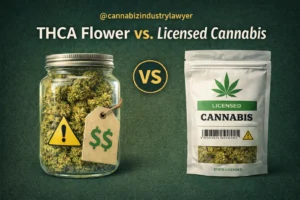
Walk into a gas station in Tennessee, a smoke shop in Texas, or a hemp retailer in a dozen other states right now, and you can buy flower that looks identical to what a licensed dispensary sells, gets you equally high, and is sold openly under federal hemp law. That product is THCA flower. It exploits a measurement loophole in the 2018 Farm Bill that the federal government has, so far, declined to close. Meanwhile, cannabis entrepreneurs are spending hundreds of thousands of dollars to obtain state licenses, comply with track-and-trace systems, and operate under regulatory frameworks that THCA sellers simply ignore. This piece explains the legal mechanics behind THCA flower vs. licensed cannabis, why it matters to anyone in this industry, and what is likely to happen to the loophole in 2026.
THCA flower vs licensed cannabis: same intoxicating effect, radically different regulatory frameworks.
How the THCA Loophole Works
The 2018 Farm Bill legalized hemp — defined as Cannabis sativa L. with a Delta-9 THC concentration of no more than 0.3% on a dry weight basis. The key phrase is “Delta-9 THC concentration.” Not total THC. Not THCA. Not Delta-9 after decarboxylation. The raw Delta-9 THC content of the harvested plant, measured before any heat processing.
THCA (tetrahydrocannabinolic acid) is the raw, non-psychoactive precursor to Delta-9 THC that exists in the cannabis plant before it is heated. A hemp plant can contain 20%, 25%, or even 30% THCA and still test at under 0.3% Delta-9 THC — technically qualifying as federally legal hemp under the 2018 Farm Bill’s measurement standard.
When you apply heat — lighting a joint, vaping, cooking into an edible — THCA converts to Delta-9 THC through a process called decarboxylation. The result is chemically identical to the Delta-9 THC that regulated dispensaries sell. The same intoxication. The same impairment. Legally, however, the pre-heat product was “hemp.”
That is the loophole. It is not subtle. It is not a gray area that requires expert legal interpretation. It is a straightforward consequence of how the Farm Bill’s definition was drafted, and it has produced a multi-billion dollar unregulated market operating openly alongside the licensed cannabis industry.
The 2018 Farm Bill’s Delta-9 THC Standard
The Farm Bill’s hemp definition came from the 2014 pilot program, which was designed to facilitate agricultural research and allow farmers in industrial hemp states to grow hemp for fiber, seed, and CBD extraction. The 0.3% Delta-9 THC threshold was a scientific standard from a 1976 research paper — it was never designed to govern a consumer intoxicant market.
The 2018 Farm Bill expanded the 2014 program into a full federal hemp legalization, removing hemp from the Controlled Substances Act entirely and transferring regulatory authority to USDA. The same 0.3% Delta-9 THC threshold carried forward. The Farm Bill’s drafters were focused on CBD and industrial hemp, not on anticipating a market that would use the definition to sell high-THCA smokable flower nationwide through unregulated retail channels.
The result: DEA and FDA have both acknowledged that THCA flower presents a difficult enforcement problem under the current statutory framework. DEA has issued guidance suggesting that THCA should be treated as a controlled substance in some contexts because of its conversion to THC, but federal enforcement of THCA sales has been inconsistent at best. Sellers have continued operating.
The Chemistry: THCA Becomes THC When You Smoke It
This point is important enough to state plainly: there is no practical difference between smoking THCA flower and smoking licensed dispensary cannabis. Both deliver Delta-9 THC to the user through decarboxylation triggered by heat. THCA flower with 25% THCA content will produce the same physiological effects as dispensary flower with 25% THC content, because the THCA converts to roughly equivalent Delta-9 THC in the combustion process (accounting for the 0.877 decarboxylation factor).
Anyone suggesting that THCA flower is a “non-intoxicating hemp product” is either scientifically illiterate or deliberately misleading their customers. The only meaningful difference is the legal framework — or lack thereof — governing the product’s production, testing, labeling, and sale.
The “Total THC” Problem
Hemp regulators have been aware of the THCA loophole for years. The USDA’s hemp regulations address this by including a “total THC” or “post-decarboxylation” testing requirement for federal hemp program compliance. The formula: Total THC = (THCA × 0.877) + Delta-9 THC. Under this calculation, a plant with 25% THCA and 0.2% Delta-9 THC would have a total THC content of approximately 22.1% — clearly not hemp.
However, the USDA’s total THC testing requirement applies to licensed hemp producers under the federal program. It does not uniformly apply to retail hemp products sold under state hemp programs, many of which have not adopted the same testing standard. The gap between production testing requirements and retail product standards has allowed THCA flower to flow from farm to consumer through channels that never subject the product to total THC testing.
State-by-State Legal Status
States are taking wildly inconsistent positions on THCA flower in 2026:
States where THCA is effectively banned or restricted: Alabama has explicitly banned intoxicating hemp products including THCA flower. Idaho’s total THC standard effectively bans it. Several other states with existing medical or adult-use programs have moved to restrict hemp-derived intoxicants.
States with licensed dispensary programs where THCA competes: In Illinois, Michigan, Colorado, and other states with established adult-use programs, THCA flower from hemp retailers competes directly with licensed dispensary products — but without the same tax burden, compliance costs, or testing requirements. Licensed operators in these states have lobbied aggressively for THCA restrictions.
States where THCA is largely unregulated: Texas, North Carolina, and several Southern states with no adult-use cannabis program have seen explosive growth in THCA retail. In the absence of specific state legislation addressing THCA, retailers have operated under the federal hemp law framework.
States with dispensary-only THCA rules: Washington State took an interesting approach — allowing THCA sales but only through licensed cannabis retailers, effectively folding THCA into the regulated market rather than trying to ban it.
The patchwork is significant. Operators and consumers crossing state lines with THCA products face different legal environments in nearly every jurisdiction. For current licensing updates in specific states, see our state licensing guides.
What Licensed Cannabis Operators Can and Can’t Do
Licensed dispensaries operating under state cannabis programs cannot sell THCA flower as a hemp product. Their products are regulated under state cannabis law, subject to state track-and-trace requirements, state-mandated testing, state excise taxes, and Section 280E at the federal level. THCA sellers in the same market operate under none of those constraints.
This creates a fundamental competitive asymmetry. A licensed Illinois dispensary pays 3% cultivation privilege tax, 7% cannabis purchaser’s excise tax plus local municipal taxes, absorbs 280E disallowance on most operating expenses, and maintains a full seed-to-sale tracking record. The THCA shop two miles away pays retail sales tax on a product it sourced from a farm that is subject to less rigorous testing. The prices are competitive. The regulatory burden is not.
Licensed operators have focused their advocacy on two strategies: pushing state regulators to ban or restrict THCA, and pushing Congress to close the Farm Bill loophole in the next reauthorization. Progress on both fronts has been slow. Meanwhile, the THCA market continues to grow. For a discussion of how this affects cannabis M&A valuations, see our cannabis mergers and acquisitions overview.
What Happens When the Farm Bill Gets Rewritten
The 2018 Farm Bill expired in 2023 and has been operating on extensions. As of early 2026, a new Farm Bill has not been enacted. When it does pass, THCA flower faces existential risk.
Multiple legislative proposals would close the loophole by adopting a total THC standard — measuring THC post-decarboxylation — as the basis for the hemp definition. Under a total THC standard, the high-THCA products that currently qualify as hemp would be reclassified as marijuana and fall back under federal controlled substance law.
The hemp industry is split. CBD and fiber producers who have nothing to do with intoxicating products favor closing the loophole to protect their market’s legitimacy. THCA producers and hemp retailers are spending heavily to preserve the current framework. The outcome is genuinely uncertain, which is exactly what makes this an area to watch closely if you have business interests on either side of the licensed/unlicensed divide.
What is clear: THCA flower’s days as a legally simple product are numbered. The question is when the law catches up to the chemistry — not whether it will.
Frequently Asked Questions
Is THCA flower legal federally in 2026?
THCA flower with Delta-9 THC below 0.3% by dry weight technically qualifies as hemp under the 2018 Farm Bill’s definition. However, DEA has issued guidance suggesting THCA may be treated as a controlled substance because of its conversion to THC, and federal enforcement has been inconsistent. The legal status is contested and likely to change when the Farm Bill is reauthorized. State law applies independently and varies widely.
Does THCA flower make you high?
Yes. When THCA flower is smoked, vaporized, or cooked, heat converts THCA to Delta-9 THC through decarboxylation. The result is the same psychoactive effect as smoking licensed dispensary cannabis with equivalent THC content. THCA in its raw, unheated form is not intoxicating, but that is not how the product is consumed.
Can a licensed dispensary sell THCA flower?
In most states with licensed cannabis programs, dispensaries sell products regulated under state cannabis law — not under federal hemp law. Whether a licensed dispensary can also sell hemp-derived THCA products depends on state law and varies significantly. Washington State allows THCA sales only through licensed retailers. Most other states have not specifically addressed the intersection of hemp THCA retail and state cannabis licensing.
Next Steps
The debate over thca flower vs licensed cannabis is the cannabis industry’s most interesting regulatory puzzle in 2026. It is legal, it is high, and it is unregulated — for now. The Farm Bill reauthorization will change that picture, and the direction of the change could dramatically reshape both the hemp retail market and the competitive position of licensed dispensaries. Smart operators on both sides of this line are watching closely and positioning accordingly.
Have questions about how THCA regulations affect your business or licensing plans?Schedule a consultation.
Disclaimer: This content discusses the legal status of THCA flower as of early 2026. Federal and state cannabis and hemp laws change frequently. This is not legal advice — consult a qualified attorney before making business decisions based on this information. State law governs in your jurisdiction.
A seasoned commercial lawyer and the Managing Director of Collateral Base. With over 15 years of experience, Tom specializes in the cannabis industry, helping businesses navigate complex regulations, secure licenses, and obtain capital. He has successfully assisted clients in multiple states and is a Certified Ganjier. Tom also runs the popular YouTube channel "Cannabis Legalization News," providing insights and updates on cannabis laws and industry trends.
A seasoned commercial lawyer and the Managing Director of Collateral Base. With over 15 years of experience, Tom specializes in the cannabis industry, helping businesses navigate complex regulations, secure licenses, and obtain capital. He has successfully assisted clients in multiple states and is a Certified Ganjier. Tom also runs the popular YouTube channel "Cannabis Legalization News," providing insights and updates on cannabis laws and industry trends.
Cannabis Industry Lawyer is a Stumari designed website for Tom Howard’s consulting business at the firm the Collateral Base, or his law firm, Howard Law Group.
On December 18, 2025, President Trump signed an executive order directing the Attorney General to expedite moving marijuana from Schedule I to Schedule III under

 That product is THCA flower. It exploits a measurement loophole in the 2018 Farm Bill that the federal government has, so far, declined to close. Meanwhile, cannabis entrepreneurs are spending hundreds of thousands of dollars to obtain state licenses, comply with track-and-trace systems, and operate under regulatory frameworks that THCA sellers simply ignore. This piece explains the legal mechanics behind THCA flower vs. licensed cannabis, why it matters to anyone in this industry, and what is likely to happen to the loophole in 2026.