On December 18, 2025, President Trump signed an executive order directing the Attorney General to expedite moving marijuana from Schedule I to Schedule III under the Controlled Substances Act. The internet celebrated like federal cannabis legalization had arrived. It had not. Three months later, marijuana is still a Schedule I substance, the DEA rulemaking is tangled in an appeal, and a new descheduling commission is reportedly in the works. If you run a cannabis business, you need to understand what this Trump cannabis rescheduling executive order actually changes — and what it does not — before you make any financial decisions based on the hype.
Here is where things stand in March 2026, what the realistic timeline looks like, and the specific steps smart operators are taking right now to prepare.
What You’ll Learn
What the Executive Order Actually Does (and Doesn’t Do)
Let’s cut through it. The executive order directs Attorney General Pam Bondi to “take all necessary steps to complete the rulemaking process” for rescheduling marijuana to Schedule III. That is direction and momentum. It is not a schedule change. Cannabis remains Schedule I right now, today, in March 2026.
An executive order cannot unilaterally move a substance between schedules. The Controlled Substances Act requires a formal rulemaking process through the DEA, with notice-and-comment periods, evidentiary reviews, and an administrative law proceeding. As the Congressional Research Service notes, the real legal event is a final agency action — typically a published final rule — supported by a defensible administrative record. The EO tells the DEA to hurry up. It does not change the law.
What the EO Does
- Signals political will: The President has publicly ordered his AG to complete the rescheduling process. That is significant for market confidence and investor sentiment.
- Directs CBD policy review: The EO also asks agencies to clarify the regulatory pathway for CBD products, which has been in limbo since the 2018 Farm Bill.
- Creates political cover: State-legal cannabis businesses can point to the EO when dealing with banks, landlords, and partners who remain nervous about federal status.
What the EO Does Not Do
- Change marijuana’s schedule: Cannabis is still Schedule I until a final rule is published and its effective date arrives.
- Remove IRC 280E: Section 280E still applies to every cannabis business in America today. Your tax bill has not changed.
- Legalize interstate commerce: Schedule III does not create a federal regulatory framework for cannabis sales. State markets remain separate.
- Fix banking: While rescheduling would reduce risk for banks, it does not create the safe harbor that the SAFER Banking Act would provide.
Where the DEA Rulemaking Stands in March 2026
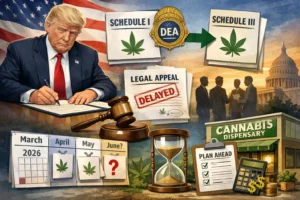 This is where it gets messy. The DOJ and DEA published a Notice of Proposed Rulemaking back in May 2024 proposing to move marijuana from Schedule I to Schedule III. That kicked off the formal process. But the process stalled — not because of scientific disagreement, but because of procedural challenges.
An interlocutory appeal is currently pending with the DEA Administrator. The appeal involves allegations of agency bias and improper communications with anti-rescheduling parties. According to a joint status report from the DEA and reform proponents, no briefing schedule has been set. Translation: the appeal is sitting there, and nobody knows when it will move.
As Ropes & Gray’s legal analysis put it, significant hurdles remain. The rulemaking must survive judicial review, and any final rule will almost certainly face legal challenges from both legalization advocates (who want descheduling, not rescheduling) and prohibition supporters (who oppose any schedule change).
Realistic Timeline Estimates
Nobody has a firm date. But based on the rulemaking process and the pending appeal, here is what a realistic timeline looks like.
| Milestone | Realistic Estimate | Notes |
|---|---|---|
| Interlocutory appeal resolved | Mid-to-late 2026 | No briefing schedule set yet |
| Final rule published | Late 2026 – early 2027 | Depends on appeal resolution and comment review |
| Effective date | 30-60 days after publication | Standard federal rulemaking timeline |
| Legal challenges filed | Immediately after publication | Expected from multiple sides |
Plan for a late 2026 or early 2027 effective date as the optimistic scenario. Plan for longer if the appeal drags out or legal challenges result in an injunction. Do not restructure your business based on a timeline that does not exist yet.
The Descheduling Commission: What We Know
Here is the plot twist nobody expected. In March 2026, reports emerged that President Trump is planning to sign another executive order this summer creating a federal commission to study descheduling marijuana entirely — removing it from the Controlled Substances Act, not just moving it to Schedule III.
The commission would reportedly consist of around a dozen members tasked with examining the potential ramifications of full descheduling, with the political timing clearly aimed at the November 2026 midterm elections. Cannabis is a popular issue across party lines, and a descheduling study commission is a low-cost way to signal progress without making a binding policy change.
What This Means for Operators
In the short term, not much. A study commission does not change the law. It does not even recommend changing the law — it studies whether the law should change. But it does signal that the political window for cannabis reform is wide open, and that the administration sees cannabis as a winning issue heading into the midterms.
The bigger question: does the descheduling commission complicate the Schedule III rulemaking? Potentially. If the political direction shifts toward full descheduling, the DEA might slow-walk the Schedule III final rule. Or Congress might try to act first. Or — most likely — both processes move in parallel on different timelines, and operators are left navigating uncertainty.
How Schedule III Kills 280E (and What That Means for Your Bottom Line)
This is why operators care about rescheduling. IRC Section 280E prohibits cannabis businesses from deducting standard business expenses — payroll, rent, marketing, insurance, utilities — because cannabis is a Schedule I substance. The only deductions available are Cost of Goods Sold (COGS). That creates effective tax rates of 70% or higher for many operators.
If marijuana moves to Schedule III, Section 280E no longer applies. The statute explicitly targets Schedule I and II substances only. The moment a final rule takes effect, every cannabis business in America can start deducting ordinary business expenses like any other legal business. That is not a marginal improvement. For most operators, it is the difference between surviving and thriving.
If you are using IRC 471(c) strategies to minimize your 280E exposure, keep doing that. Those strategies remain your best tool until the schedule change is finalized. Do not abandon your current tax position based on an executive order that has not yet resulted in a rule change.
The Operator Playbook: What to Do Right Now
You should be treating 2026 as a change-in-law preparation year. Here is the playbook.
1. Map Your Chart of Accounts for Post-280E Deductions
Work with your CPA to restructure your chart of accounts so that ordinary deductions — rent, payroll, marketing, admin — can be activated the moment 280E no longer applies. You want to be ready to file amended returns or shift your quarterly estimated payments on the day the final rule publishes. Do not wait until the rule drops to figure out your accounting.
2. Model Your Post-280E Financials
Build two financial models: one with 280E in place, one without. Calculate how much lower your federal tax liability will be when normal deductions become allowable. Update your forecasts to reflect increased after-tax cash flow. If you are raising capital or negotiating a deal, you need this analysis ready to show investors and lenders.
3. Identify Tax Credits You Have Been Missing
Schedule III opens the door to federal tax credits that are currently unavailable to cannabis businesses, including the Research & Development (R&D) credit, the Work Opportunity Tax Credit, and energy efficiency credits. Start identifying potential credits now and collecting the documentation to support claims. Even if you can only claim them once the rule takes effect, preparing now ensures you capture every available benefit.
4. Clean Up Your Compliance Documentation
Rescheduling will accelerate M&A activity. If you are a potential acquisition target — or buyer — get your compliance documentation diligence-ready now. Clean financials, consistent SOPs, up-to-date state licenses, and accurate seed-to-sale records will matter more than ever when capital starts flowing into the industry post-280E.
5. Do Not Over-Leverage on a Timeline
This is the most important point. Do not take on debt, sign leases, or make expansion commitments based on 280E relief arriving by a specific date. The rulemaking process has been slow, the appeal is unresolved, and legal challenges will come. Plan for relief, prepare for delays.
Frequently Asked Questions
Did Trump’s executive order reschedule marijuana?
No. The executive order signed on December 18, 2025, directs the Attorney General to expedite the rulemaking process for moving marijuana from Schedule I to Schedule III. Cannabis remains a Schedule I substance until the DEA publishes a final rule and the effective date arrives. The EO provides direction, not a schedule change.
When will cannabis become Schedule III?
No firm date exists. The DEA rulemaking process is complicated by a pending interlocutory appeal with no briefing schedule set. Optimistic estimates point to late 2026 or early 2027 for a final rule, but legal challenges could delay the effective date further. Operators should prepare for relief while planning for delays.
Does 280E still apply to cannabis businesses in 2026?
Yes. IRC Section 280E continues to apply to all cannabis businesses as of March 2026. The tax provision targets businesses trafficking in Schedule I and II controlled substances. It will no longer apply to cannabis only after a final DEA rule moves marijuana to Schedule III and the rule’s effective date arrives.
What is the cannabis descheduling commission?
Reports in March 2026 indicate that President Trump plans to sign an executive order this summer creating a federal commission to study removing marijuana from the Controlled Substances Act entirely. The commission would consist of approximately a dozen members and is widely viewed as a midterm election strategy. A study commission does not change the law — it examines whether the law should change.
Next Steps
The Trump cannabis rescheduling executive order is real momentum — but it is not the finish line. Smart operators are using this window to prepare their accounting, model post-280E economics, and get compliance-ready for the M&A wave that will follow schedule change. The operators who treat this as a preparation year — not a celebration — will be the ones who come out ahead.
Need help mapping your post-280E tax strategy or getting your compliance documentation deal-ready? Schedule a consultation with our team and we will build your preparation plan.
Disclaimer: This article discusses federal cannabis policy as of March 2026. The DEA rulemaking process, legislative action, and executive orders are subject to change. This is general legal commentary and does not constitute legal or tax advice. Consult a qualified attorney and CPA in your jurisdiction before making business decisions. This article does not create an attorney-client relationship.