
The medical marijuana rescheduling order everyone assumed was stuck in committee showed up alive on April 23, 2026. Acting Attorney General Todd Blanche signed an order that drops FDA-approved marijuana drug products and state-licensed medicinal marijuana from Schedule I to Schedule III — effective immediately. Recreational stays Schedule I. Unlicensed operators stay Schedule I. But if you hold a state medical license and you are still running your books on last week’s 280E assumptions, stop reading this and call your CPA. Then come back. We’ll wait.
This is the biggest federal cannabis move since the Controlled Substances Act was written, and nobody did it through DEA. They did it through a treaty. Here is what actually happened, what it means for operators, and the five things you need to be doing this week.
What the Medical Marijuana Rescheduling Order Actually Does
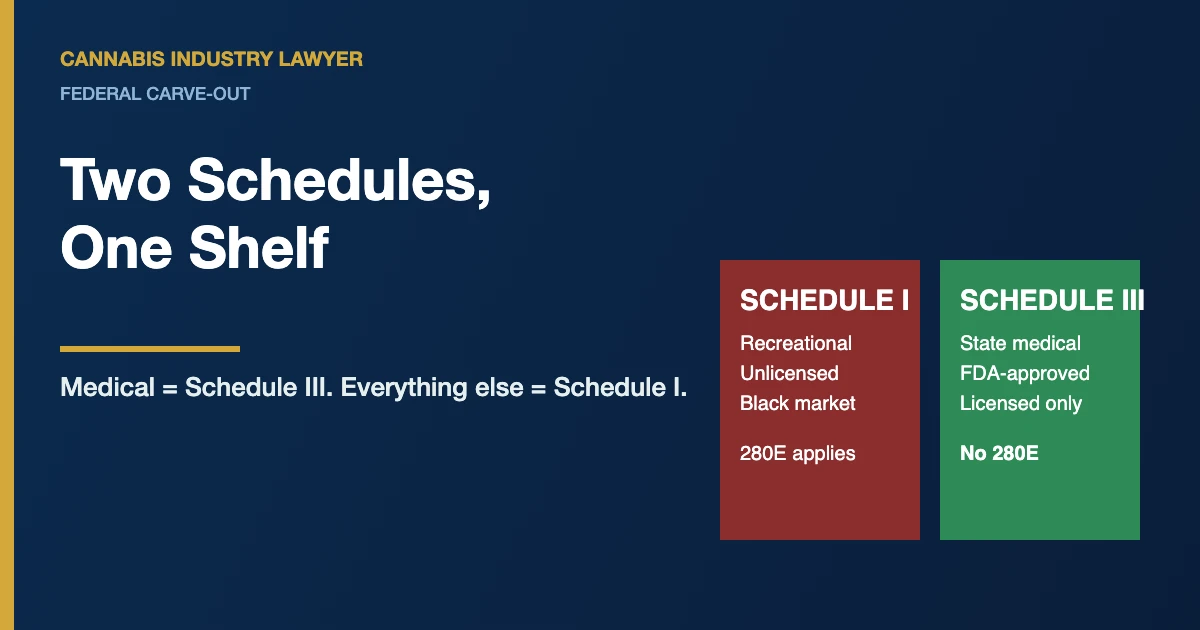
On April 23, 2026, Acting AG Todd Blanche signed an order placing two narrow categories of marijuana into Schedule III of the Controlled Substances Act: FDA-approved marijuana drug products, and marijuana held under a state medical marijuana license. Everything else — recreational, unlicensed, black market, gray market, “hemp-adjacent” products that never were — stays Schedule I.
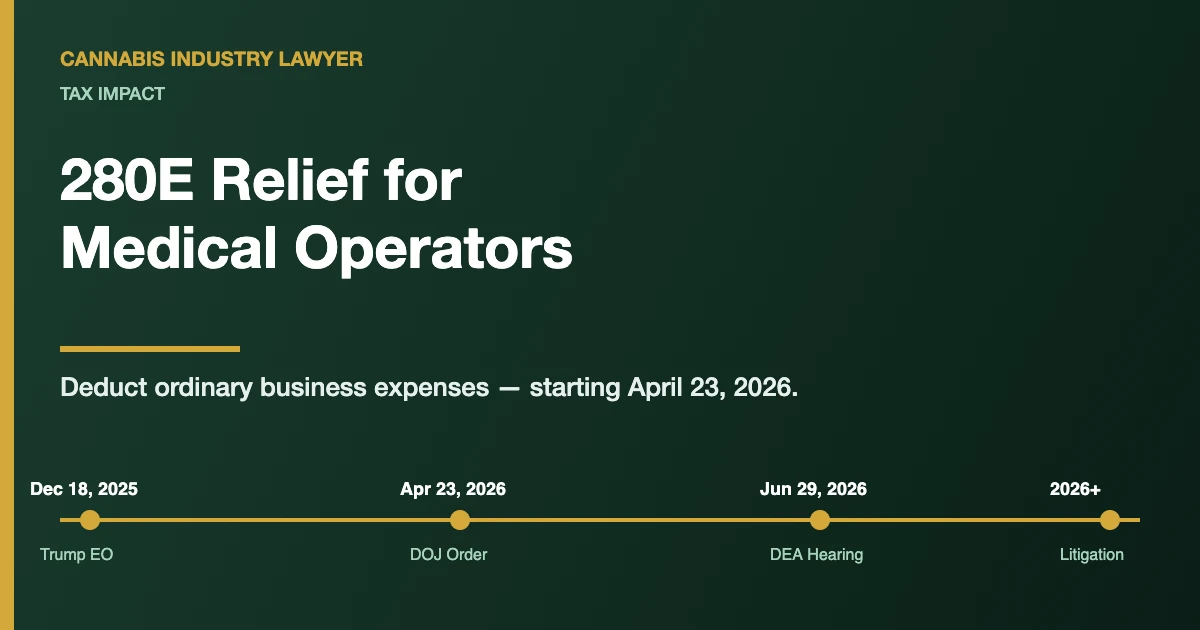
The order is effective immediately. It implements President Trump’s Executive Order of December 18, 2025, which directed DOJ to use every available authority to reclassify medical cannabis. Blanche used the one that moves fastest: the United States’ obligations under the Single Convention on Narcotic Drugs, a treaty that allows the Attorney General to reschedule substances when needed to honor international drug control commitments. That authority exists in the CSA itself at 21 U.S.C. § 811(d), and it does not require the years-long DEA rulemaking that sank the Biden-era effort.
That is the whole trick. DEA was never going to finish a rescheduling process on a schedule any cannabis operator could survive. Blanche walked around DEA and used treaty power to do it in one document. Whether that survives the litigation that is absolutely coming is a separate question — but as of this morning, it is the law.
What’s Still Schedule I After the Medical Marijuana Rescheduling
Before anybody celebrates with a press release calling themselves a “Schedule III company,” read the order’s own words:
“Preliminarily, it should be noted that any form of marijuana other than in an FDA-approved drug product or marijuana subject to a state medical marijuana license remains a schedule I controlled substance, and those who handle such material remain subject to the regulatory controls, and administrative, civil, and criminal sanctions, applicable to schedule I controlled substances set forth in the CSA and DEA regulations.”
Translation for operators: every adult-use gummy on your shelf is still Schedule I. Every pre-roll in your recreational SKU list is still Schedule I. The hemp-derived THC beverage you’ve been selling next door is still whatever it was yesterday. The federal Trump cannabis rescheduling executive order did not legalize cannabis. It did not decriminalize cannabis. It created a narrow federal carve-out for two very specific categories.
If you are a vertically integrated operator with both medical and adult-use under the same roof, you now have two different federal schedules sitting on the same shelf. That is a compliance problem and an accounting problem and a banking problem, and we’ll get to all three.
The 280E Relief You Just Earned (If You Qualify)
IRC § 280E prohibits deductions for businesses “trafficking” in Schedule I or Schedule II controlled substances. Schedule III is not on that list. Congress did not forget to include it — Congress deliberately wrote 280E to reach only the top two schedules. That means a state-licensed medical marijuana business whose product is now federally Schedule III can deduct ordinary and necessary business expenses like any other taxpayer. Rent. Wages. Marketing. Legal fees. All of it.
That is the single biggest financial event in the history of the industry. For a medical dispensary running at typical margins, dropping off 280E can mean recapturing 15 to 30 points of effective tax rate. The math changes from “we survive” to “we expand.”
Before you rewrite your tax return in pencil, know the complications. The order is effective today, not retroactively, so your 2025 return is still 280E. Your 2026 return becomes a split year — pre-April 23 and post-April 23 — and the IRS will want that allocation defended. If you are a mixed-use operator selling both adult-use and medical, you must segregate inventory and revenue at the SKU level, because the Schedule III benefit only reaches the medical side. And your entity structure matters: C-corps, S-corps, LLCs taxed different ways, each get treated differently under this transition.
This is where you need help. We work with Collateral Base’s cannabis consulting team on operational restructuring for exactly this scenario — chart of accounts cleanup, inventory segregation, tax attribution, and the compliance SOPs you need before the IRS decides to audit the first wave of post-rescheduling medical operators. They will.
Why the Single Convention Treaty Authority Matters for Medical Marijuana Rescheduling
The DEA rescheduling process is the “normal” path — notice, comment, hearing, final rule, litigation, delay. The Biden administration started it. It was still crawling when the Trump administration took over. The expected timeline on the formal DEA path was another 12 to 18 months, minimum, and that assumes no further legal challenges.
Treaty authority is different. The Single Convention on Narcotic Drugs places certain substances in international Schedule II, which under domestic implementation must sit no lower than federal Schedule III. DOJ has argued — and now acted on — the position that the Attorney General can move substances between schedules where needed to keep the U.S. in compliance with that treaty. That authority was sitting there the whole time. It just took an administration willing to use it.
Expect the litigation. State attorneys general, prohibitionist groups, and at least one drug policy think tank will file challenges within 30 days. The order stays in effect while those challenges proceed, which is the point. The question is whether the order survives final review — and the related question of whether the Trump administration pushes through a permanent DEA rule before any reviewing court can unwind it. See our analysis of the full Schedule III timeline and the CRA “major rule” delay for the procedural context.
The June 29, 2026 Expedited Hearing
DEA already announced an expedited rescheduling hearing for June 29, 2026. That hearing was scheduled before the Blanche order and is now functionally a question about whether to expand the rescheduling to all marijuana — adult-use included — or to leave the carve-out as the ceiling. It is the closest thing to a referendum on full federal legalization that the administrative state is going to produce in 2026.
If your operation has a stake in adult-use being pulled into Schedule III, this is the hearing where that fight happens. Prepared written comments are the way operators participate. Individual dispensary owners don’t get on the witness list, but well-drafted comments from counsel do get read, cited, and used. We will have more on the comment strategy in the coming days.
5 Things Operators Must Do This Week
No reason to sugarcoat it — this week is the most important operational week your company will have in 2026. Here is the punch list.
1. Call your CPA today. Not tomorrow. Today. You need a sit-down on your 2026 transition — how you’re going to allocate pre- and post-April 23 revenue, whether you’re going to restate any prior-year positions, and what estimated tax payments look like now that you’re no longer 280E on the medical side.
2. Segregate inventory at the SKU level. If you are a mixed operator, every medical SKU and every adult-use SKU needs to be tracked separately in your seed-to-sale system and your POS. Your state compliance team probably already does this, but you need finance and tax ready to produce the allocation in an audit.
3. Talk to your banking relationship. Some institutions will read Schedule III as the trigger they’ve been waiting for to normalize your accounts. Others will get more nervous because mixed Schedule I / Schedule III portfolios are a compliance nightmare for them. Know which kind of bank you have and ask the question this week.
4. Review your corporate structure. Schedule III changes the math on which entity type is optimal. It may make sense to carve the medical side into its own entity — or to collapse a holding structure you set up specifically to manage 280E exposure. Our colleagues at Howard East’s corporate law practice handle exactly this kind of post-reclassification restructuring, particularly for operators with multi-state footprints.
5. Do not relax on compliance. This is the trap. Schedule III does not mean your state license got easier. It means the federal government is now paying attention to whether your state license is actually valid, because the federal carve-out only applies to “marijuana subject to a state medical marijuana license.” If your state compliance is sloppy, you are no longer Schedule III — you are Schedule I. State audits will matter more after this order, not less.
What This Medical Marijuana Rescheduling Order Does Not Do
Because everyone is going to overreact one way or the other, it’s worth listing what did not change:
- Marijuana is not federally legal. It is scheduled. Scheduled is not legal.
- Adult-use is not affected. If you sell recreational, the federal criminal exposure that existed on April 22 still exists on April 24.
- Interstate commerce is not opened. You cannot ship medical product across state lines even if both states are Schedule III, because federal permits are still required for Schedule III transport and those don’t exist for marijuana.
- The SAFE Banking Act is not passed. Banks have more reason to lean in, but the underlying statute has not changed.
- Your state’s prohibition or regulatory regime is not preempted. If your state does not have a medical program — Indiana, for example — the carve-out does not reach you, because there is no “state medical marijuana license” for your product to sit inside.
This is the federal government moving a specific, narrow category of medical cannabis into a less-bad federal schedule. It is historic. It is also limited. Understanding the shape of the limit is more valuable today than celebrating the move.
What Comes Next After Medical Marijuana Rescheduling
The order goes to the Federal Register this week. Litigation will land shortly after. The June 29 hearing will take up whether to expand Schedule III to all marijuana. Congress, which has been waiting for cover, may finally move on SAFE Banking and on a fuller cannabis framework now that the executive branch has blinked first. Expect a flood of state-level activity too — medical programs that were dormant will suddenly get interesting, and adult-use states will start asking why they can’t capture the same tax benefit.
For operators, the work is the same as it always was: get your compliance tight, get your books clean, and be ready to move faster than the regulators. The medical marijuana rescheduling order bought state-licensed medical operators roughly ten years of headroom on tax and banking. The ones who spend this quarter rebuilding their operations for a post-280E world are going to look back on April 23, 2026 as the day the business actually started.
Get Ahead of the Medical Marijuana Rescheduling Fallout
If you hold a state medical marijuana license and you are not sure what to do with this week, send us a message. We handle licensed cannabis operator matters — tax restructuring, entity formation, compliance review, and federal regulatory risk — and we are triaging calls from medical operators in every state that has a program. The operators who get this right in April will be compounding the advantage for the rest of the year. The operators who wait for “more clarity” will be waiting a year while everyone else’s margins improve.
Schedule a consultation with our cannabis law team. We’ll get you out of the 280E mindset and into the Schedule III playbook.